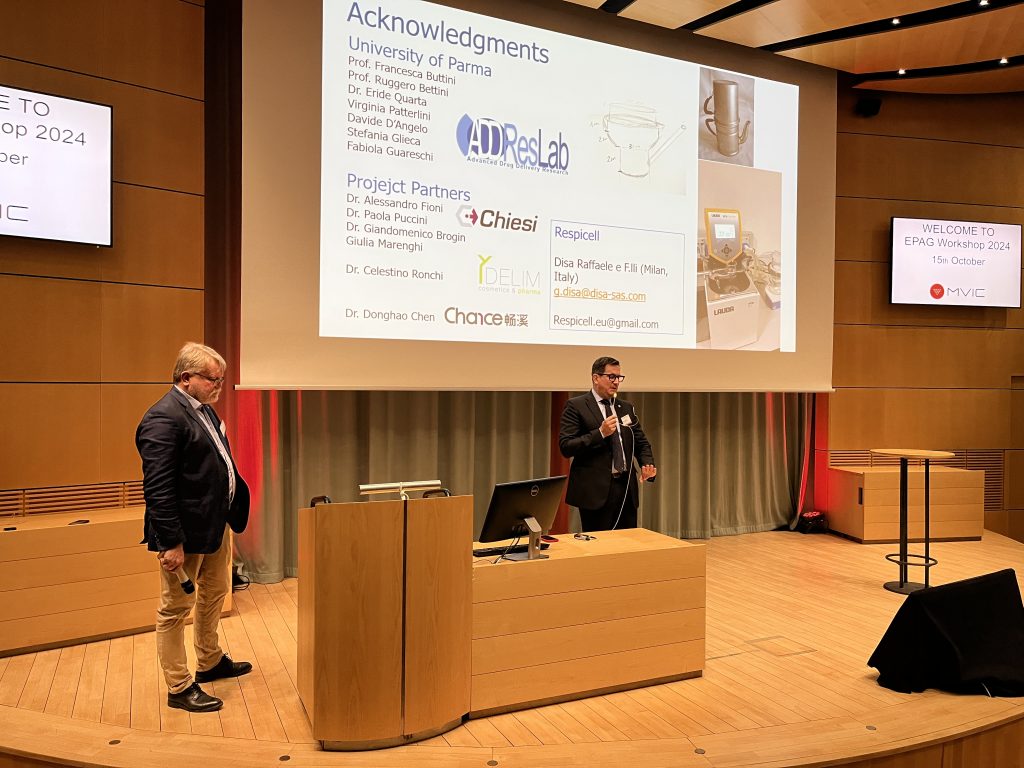
Dissolution Workshop, 15 October 2024
Organized by: EPAG Dissolution Sub-Team
Chairs: Joe Takher-Smith and Per Bäckman
Workshop Objectives
To explore the evolving landscape of dissolution testing for orally inhaled drug products (OIDPs), with a focus on regulatory relevance, in vitro–in vivo correlations (IVIVC), mechanistic modeling, and practical implementation in R&D.
Session Highlights
1. Introduction – Joe Takher-Smith (EPAG / Viatris)
Joe introduced the workshop and gave a brief overview of EPAG’s history, structure, and collaborative ethos. He then focused on what the EPAG dissolution sub-team had achieved in the previous years. how the regulatory expectations have changed with respect to dissolution testing for inhaled products. This included highlighting recent updates to FDA Product Specific Guidances for generic product development, which now include dissolution comparisons between the Test and Reference products.
2. RespiCell Apparatus – Fabio Sonvico (University of Parma)
Fabio presented the RespiCell™, a vertical diffusion cell for dissolution testing of respirable fractions which were captured on a fiber filter using a Fast Screening Impactor. The approach was exemplified by some brilliant case studies showing how formulation composition, processing equipment type and controlled release mechanisms were understood by using the apparatus. Fabio also highlighted the use of functionalized membranes and mucus simulants to mimic lung environments.
3. Sink or Swim: USP2 Dissolution Methodology – Andy Cooper (Viatris)
Andy started his presentation by setting out what the technical requirements for an inhaled dissolution method were. He highlighted some of the issues that have arisen when using “paddle-over-filter” methodology. He then presented a case study of how a liquid impingement dose collection method had been used to help understand the effect of dissolution rate on in vivo exposure in a pharmacokinetic study.
4. Dissolution, Permeation & Systemic Distribution – Per Gerde (Inhalation Sciences / Karolinska Institutet)
Per identified five key knowledge gaps in the iBCS framework and proceeded to discuss case studies and literature which exemplified them. He showcased the PreciseInhale™ and DissolvIT™ platforms for controlled aerosol exposure and perfused lung studies, emphasizing the importance of measured data over theoretical assumptions in PK modeling.
5. Predicting In Vivo Dissolution – Bo Olsson (Emmace / Mimetikos)
Bo discussed how he has translated in vitro dissolution curves into in silico simulations by parameterizing the data into a median diameter and geometric standard deviation. This is fitted to a numerical solution of the differential equation defining the dissolution process. This can then be used to simulate the compound pharmacokinetics in a mechanistic model, which he demonstrated using Mimetikos Preludium™ software. Finally, Bo presented validation examples including Advair Diskus with excellent alignment between simulated and observed PK.
6. IVIVC in Other Dosage Forms – Prof. Nikoletta Fotaki (University of Bath)
Nikoletta gave an excellent overview of IVIVC and PBPK modeling in oral and parenteral dosage forms, which provided context for where the current experience base for inhaled development was and where it may go in the future. She discussed challenges in IVIVC development and importance of mechanistic deconvolution, and shared case studies in paediatrics and critically ill patients, highlighting tailored media and modeling approaches.
Panel Discussion, Summary & Key Takeaways
The workshop concluded with a panel discussion including all the presenters, with additional questions from the audience. The topics ranged from specific technical queries about the presentations to broader areas such as the lack of standardized apparatus, and whether a consortium approach to apparatus creation, similar to the way the Next Generation Impactor was developed, could be an option.
It was clear that dissolution testing is increasingly central to inhaled product development, bridging formulation science with clinical performance. Modeling tools that incorporate dissolution data to PBPK models are commercially available, and the recognition of in silico approaches is growing for inhaled dosage forms. Regulatory momentum is growing, particularly in the US, with dissolution now featured in guidance for inhaled bioequivalence.